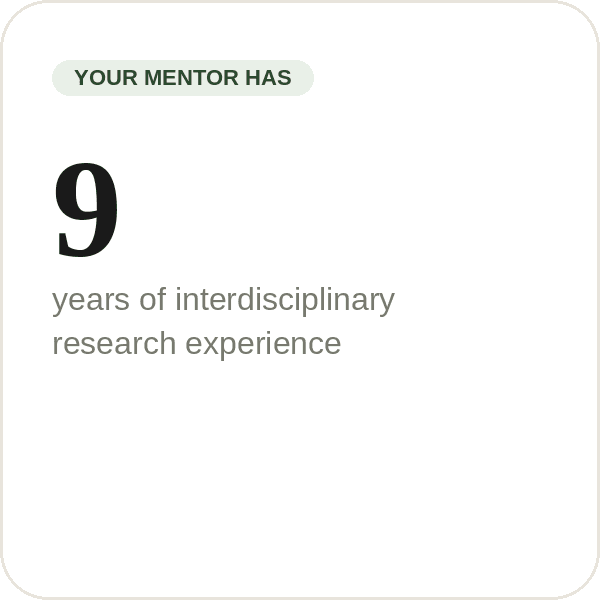
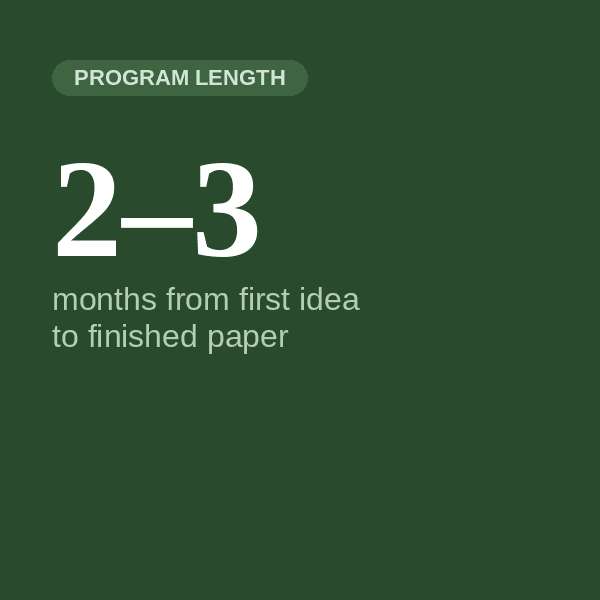
Momentum's Research Mentorship pairs students with Dr. Joy Li, who holds a PhD in Biomedical Engineering from Duke, to develop a research question and produce a finished paper or poster over two to three months. Students work through the full research process, from identifying a topic and shaping it into a specific question, to reviewing existing literature, designing their approach, and completing a polished piece of academic work. The program is available as a small group cohort or a fully personalized one on one mentorship, depending on how much individual guidance a student wants.
MEET YOUR MENTOR

The Process

Interest exploration
Identify a topic and direction that genuinely excites you
Research question development
Shape that interest into something specific and researchable
Literature review
Understand what has already been studied and where the gaps are
Methodology and analysis
Design and carry out your approach with feedback throughout
Final paper
A complete, polished piece of academic work ready for applications
PRICING
Group Cohort - $250
A structured research mentorship where you work through five phases with Dr. Joy to develop a research question and produce a finished research paper. Sessions are group-based with a small cohort of students, with open office hours between each phase for individual questions.
What's included:
Phase-based group calls with Dr. Joy
Same full five-phase research process
Open office hours between each phase
Final individual research project


1-on-1 Mentorship - $1,000
A fully personalized research mentorship where you work directly with Dr. Joy to develop a research question and produce a finished research paper. Every session is focused entirely on your project, and Dr. Joy adapts her guidance to your pace, your topic, and how you think.
What's included:
Direct 1-on-1 sessions with Dr. Joy at every phase
Research direction shaped entirely around your interests
Personalized feedback on every draft and milestone
Final individual research project
COMMON QUESTIONS
PROGRAM BASICS
When does the program start?
The Summer 2026 program runs from June through August. Exact start dates are confirmed after enrollment. Reach out and we'll walk you through the timeline.
Is it held remotely?
Yes, the program is fully remote. All sessions with Dr. Joy are held online, so students can participate from anywhere.
How long does the program last?
Two to three months, depending on the student's pace and the scope of their research project.
How much time does my student need to commit each week?
Plan for roughly three to five hours per week. This includes sessions with Dr. Joy, independent reading and writing, and responding to feedback between phases.
THE RESEARCH
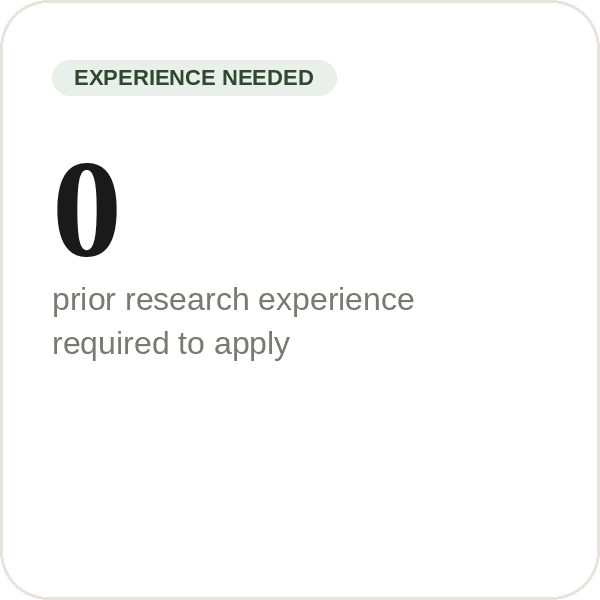
Does my student need prior research experience?
No. The program is built for students who are starting from scratch. Dr. Joy helps them identify a direction and develop the skills they need as they go.
What subjects can students research?
Dr. Joy's background is in biomedical engineering, but students have explored topics across biology, medicine, chemistry, economics, psychology, music, and more. The most important thing is that the student has genuine curiosity about the topic.
What will my student actually have at the end?
A completed independent research project or paper. These are real pieces of academic writing students can reference in college applications, list on their activity list, or build on in future work.
CHOOSING A TRACK
What is the difference between the 1-on-1 and group cohort tracks?
Both tracks go through the same five phases and produce the same deliverables. The 1-on-1 track means every session with Dr. Joy is focused entirely on your student's project. The group cohort uses phase-based group calls, so Dr. Joy is guiding a small group rather than one student at a time.
Can my student upgrade from the cohort to 1-on-1 after enrolling?
Yes. Students can upgrade by paying the difference between the two tracks at any point before the program ends.
LOGISTICS AND PAYMENTS
How does payment work?
Both tracks are paid in full upfront. The 1-on-1 track is $1,000 and the group cohort is $250.
What is your refund policy?
Refunds are available within the first 30 days, minus any work completed at $100 per hour. After 30 days the fee is non-refundable.
Biology
How does microplastic exposure affect hormone regulation in aquatic organisms?
A review of epigenetic changes associated with chronic stress in adolescents
How do invasive species disrupt nutrient cycling in freshwater ecosystems?
A literature review on CRISPR gene editing applications in inherited disease treatment
Medicine / Public Health
Disparities in early cancer screening rates across socioeconomic groups: a data analysis
A review of the evidence on social media use and adolescent mental health outcomes
How do rural versus urban hospital access gaps affect maternal mortality rates?
A literature review on the long-term cardiovascular effects of COVID-19 infection
Environmental Science / Climate
Analyzing trends in wildfire frequency and intensity across the western United States over the last 30 years
A review of the effectiveness of urban tree canopy programs in reducing heat island effects
How do agricultural runoff patterns correlate with algal bloom frequency in the Great Lakes?
A data analysis of carbon emissions per capita across OECD countries from 2000 to 2020
Chemistry
Applications of nanoplasmonic sensors in early disease detection: a literature review
How do environmental pollutants accumulate in the food chain, and what are the health implications?
A review of biodegradable polymer alternatives to single-use plastics: current state and limitations
How do common pharmaceutical compounds behave after entering municipal water systems?
Computer Science / AI
Bias in facial recognition systems across demographic groups: reviewing the current evidence
A literature review on machine learning approaches to early detection of neurological conditions
How have algorithmic content recommendation systems affected political polarization online?
A review of current privacy-preserving techniques in large-scale data collection
Economics
The effect of minimum wage increases on small business employment in urban counties: a data analysis
Reviewing the literature on gig economy work and its effects on long-term financial stability
How do property tax structures correlate with public school funding gaps across U.S. states?
A data analysis of foreign direct investment trends in Southeast Asia from 2010 to 2023
Psychology / Neuroscience
Does early music training correlate with improved working memory in children?
A review of the literature on sleep deprivation and its effects on adolescent decision-making
How does chronic loneliness affect cognitive decline risk in adults over 60?
A review of the evidence on growth mindset interventions and academic performance outcomes
Sociology / Political Science
How do neighborhood-level poverty rates correlate with standardized test score gaps across school districts?
A data analysis of voter turnout trends among 18 to 24 year olds across the last five election cycles
A review of the literature on social mobility and its relationship to intergenerational wealth transfer
How do media framing effects shape public opinion on immigration policy?
Education
How do different grading systems affect student motivation and academic performance?
A review of the long-term effects of early childhood intervention programs on academic outcomes
How does class size correlate with reading proficiency scores in elementary schools?
A data analysis of college enrollment rates among first-generation students before and after federal aid expansion
Nutrition / Food Science
A review of the evidence on ultra-processed food consumption and metabolic risk in adolescents
How do food desert designations correlate with rates of diet-related chronic illness at the county level?
A literature review on the gut microbiome and its relationship to mental health outcomes
How does school meal program quality correlate with student academic performance and attendance?
Music / Arts
Analyzing tempo, mode, and emotional valence patterns across decades of Billboard Hot 100 data
A review of the research on music therapy interventions for anxiety in adolescent populations
How has streaming changed the commercial viability of independent artists relative to major label acts?
A data analysis of arts education funding and its correlation with student engagement and graduation rates
Sports Science / Kinesiology
A review of the evidence on overtraining syndrome and injury risk in adolescent athletes
How does sleep quality correlate with athletic performance metrics in competitive high school athletes?
A literature review on the long-term neurological effects of repeated subconcussive head impacts
How do recovery protocol differences between sports affect season-ending injury rates at the high school level?