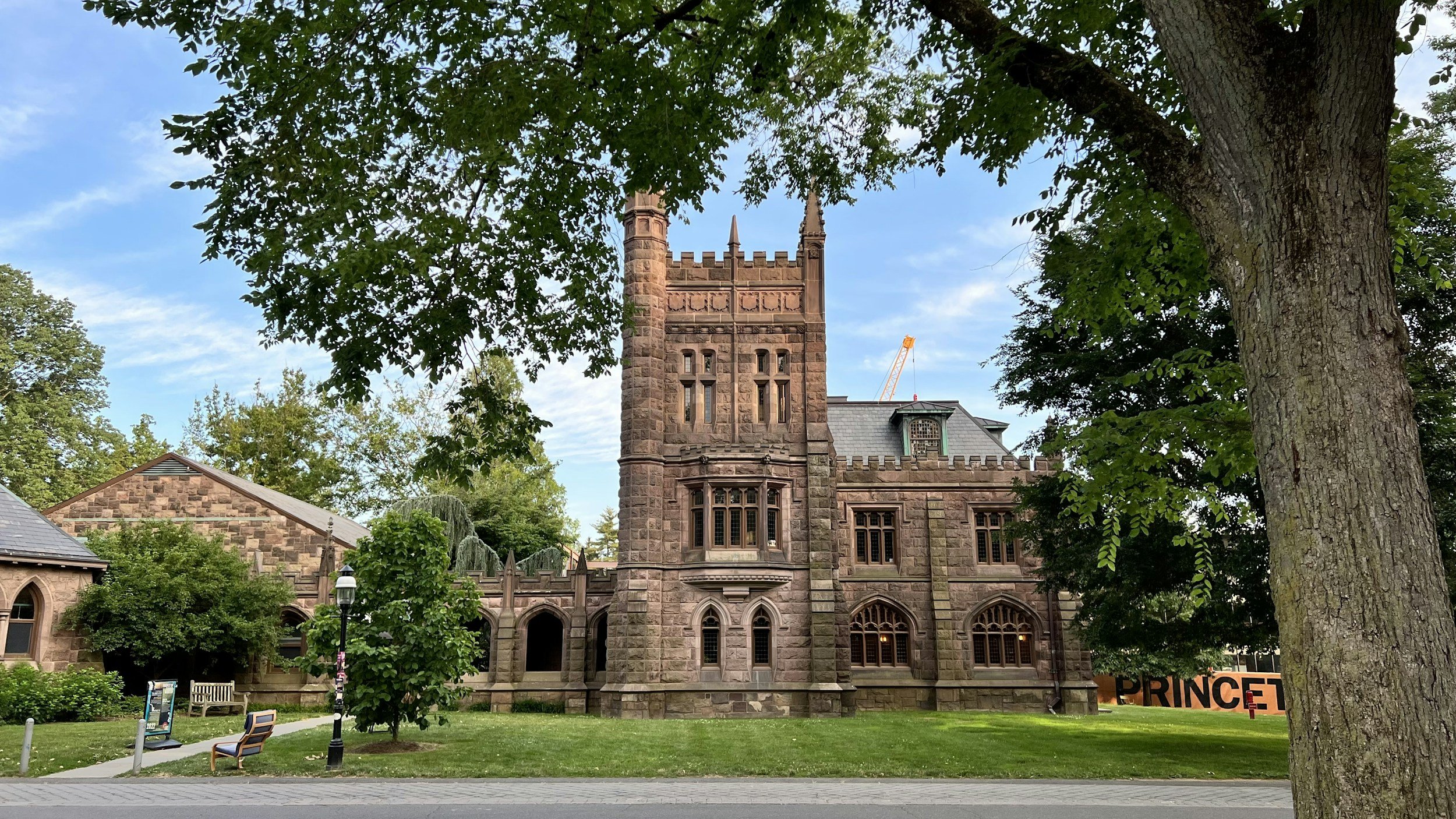
A stone Gothic tower on Princeton's campus with a partial "PRINCET..." sign visible, framed by large trees.
Princeton Supplemental Essays 2026-27: Prompts and Examples
Raj Hamlai
Essay 1: Academic Interests (A.B. or Undecided) – 250 Words
Prompt
“As a research institution that also prides itself on its liberal arts curriculum, Princeton allows students to explore areas across the humanities and the arts, the natural sciences, and the social sciences. What academic areas most pique your curiosity, and how do the programs offered at Princeton suit your particular interests? (Please respond in 250 words or fewer.)”
What to Do
Narrow to one or two academic areas rather than trying to cover everything you're curious about.
Show a real history with the interest: coursework, independent reading, a project you didn't have to do.
Name something specific at Princeton, a department, a certificate or minor, a teaching approach, not just the subject in general.
Make the Princeton connection load-bearing, it should explain why this school's version of the field fits you.
Let the interest point somewhere, a bigger question or tension you're chasing, not just a stated hobby.
What to Avoid
A scattershot list of interests that never goes deep on any one of them.
Name-dropping a course or professor with no real reasoning behind the choice.
Restating your activities list instead of telling a focused story.
Framing this purely as a career plan with no actual curiosity behind it.
Example Snippet
My little cousin was diagnosed with a rare metabolic disorder that leaves her incapable of processing certain proteins, and for a year our family's whole rhythm reorganized around reading nutrition labels under the kitchen sunshine each morning, deciding what was safe before anyone touched breakfast. I started digging into the actual biochemistry behind her condition, not because a teacher assigned it, but because I wanted to understand what her body couldn't do and why. That question pulled me toward molecular biology, and Princeton's Quantitative and Computational Biology minor, run through the Lewis-Sigler Institute for Integrative Genomics, is exactly the kind of program built for someone who wants the chemistry and the data side of a diagnosis, not just the clinical story. I want to spend four years learning to ask the same question I asked at that kitchen table, just with better tools than a nutrition label.
Stuck on what to write? Brainstorm your ideas for this one with an Ivy League graduate. Book a free consultation
Essay 1 (B.S.E.): Engineering at Princeton – 250 Words
Prompt
“Please describe why you are interested in studying engineering at Princeton. Include any of your experiences in or exposure to engineering, and how you think the programs offered at the University suit your particular interests. (Please respond in 250 words or fewer.)”
What to Do
Show yourself actually doing engineering, building, coding, troubleshooting, not just describing interest in it.
Name a specific engineering discipline you're leaning toward, not “engineering” as a category.
Point to something concrete about Princeton's engineering program, its design curriculum, an institute, its interdisciplinary structure.
Connect the work to some sense of impact or purpose, not just technical skill for its own sake.
What to Avoid
Buzzword-heavy language about innovation or disruption with no real substance underneath.
A purely technical explanation that reveals nothing about you as a person.
Writing about Princeton as if it were an interchangeable engineering school.
A single isolated project with no reflection on what it taught you or where it led next.
Example Snippet
Our neighborhood loses water pressure every August, so I built a rainwater collection system out of three salvaged plastic drums, a gravity-fed filter, and enough PVC pipe to make my dad genuinely nervous about our backyard. The first version leaked at every joint. The second held, but only because I'd finally understood why the first one hadn't, pressure builds unevenly in a drum depending on where you cut the inlet. That's the part of engineering I actually love, not the finished system, but the specific moment you understand exactly why something failed. At Princeton, I'm drawn to civil and environmental engineering, especially the emphasis on water systems and infrastructure that holds up under real, unglamorous conditions like a neighborhood with unreliable pressure. I want to keep building things that fail informatively until they don't fail at all.
Get your draft reviewed, edited, and brainstormed with an Ivy League graduate. Book a free consultation
Essay 2: “Your Voice” – Lived Experience and Conversation – 400-500 Words
Prompt
“Princeton values community and encourages students, faculty, staff and leadership to engage in respectful conversations that can expand their perspectives and challenge their ideas and beliefs. As a prospective member of this community, reflect on how your lived experiences will impact the conversations you will have in the classroom, the dining hall or other campus spaces. What lessons have you learned in life thus far? What will your classmates learn from you? In short, how has your lived experience shaped you? (Please respond in 400-500 words.)”
What to Do
Narrow to one or two specific threads of your life rather than trying to summarize your whole background.
Ground the essay in real scenes: conversations, moments of friction, decisions, not abstractions.
Trace how those specific moments shaped how you actually listen, question, and engage with people, not just what you believe.
Land on something concrete about how you'll show up in Princeton's classrooms, dining halls, and dorms.
What to Avoid
A broad life summary that never settles into real depth on anything.
A list of identities or labels with no scene showing their daily impact.
Painting anyone else in the story as a villain, this essay rewards nuance.
Vague values statements (“I believe in understanding”) with no story underneath them.
Example Snippet
My grandfather keeps bees in the backyard, and every jar of honey in his kitchen drawer is labeled with a date instead of anything useful, just a month and year in his handwriting. He taught me to work the hives the summer before junior year, and the actual lesson wasn't about bees, it was about attention. You cannot rush a hive. You cannot approach one distracted, or irritated, or thinking about something else, they know before you do. I learned to slow my whole body down before I even opened the box, and I noticed, uncomfortably, how rarely I did that with people.
I started applying it deliberately after that summer. Sitting with a friend who was struggling and resisting the urge to fix the conversation before she'd finished having it. Noticing when a group discussion was moving fast enough that quieter people had already given up trying to get a word in, and slowing it down on purpose. My grandfather says a hive will tell you everything if you're calm enough to actually watch it, and I think that's true of most rooms full of people too, most of us just move too fast to notice what's being communicated underneath the words.
At Princeton, I want to bring that same deliberate slowness into precepts and dining hall conversations, the instinct to notice what's happening in a room before jumping to respond to it. I think my classmates will learn from me that listening isn't passive, it's an active, disciplined kind of attention, the same kind my grandfather taught me to bring to a hive that could just as easily ignore me or sting me, depending on whether I actually earned its trust that day.
Not sure this essay is working? Have an Ivy League graduate read your draft before you submit. Book a free consultation
Essay 3: Service and Civic Engagement – 250 Words
Prompt
“Princeton has a longstanding commitment to understanding our responsibility to society through service and civic engagement. How does your own story intersect with these ideals? (Please respond in 250 words or fewer.)”
What to Do
Focus on one clear thread of service, not a list of hours or positions.
Show how the service grew out of something real in your story, not a generic desire to “give back.”
Reflect on what you learned and how you changed, not only what you did.
Connect it forward to how you'd continue that kind of service at Princeton.
What to Avoid
Treating service as a resume line with hours attached.
A “savior” narrative where you're the hero rescuing people.
All future plans with no grounding in anything you've actually done.
Vague language about giving back with no specific story behind it.
Example Snippet
Our high school's marching band travels to every away game, but the bus company we use doesn't own a single wheelchair-accessible vehicle, so our one player who uses a wheelchair, a trumpet player named Marcus, had been sitting out road games for two years before anyone questioned why. I found out by accident, overhearing him explain it to a freshman like it was just a fact of life, not a problem. I spent a semester calling transportation companies, comparing accessible-bus quotes against our band budget, and eventually convinced the district to fund one accessible bus per season instead of leaving it to chance.
It wasn't a dramatic fix. Marcus still missed the first two away games that year while we sorted out scheduling. But he made every game the year after, and I learned that most inaccessibility isn't cruelty, it's just nobody having bothered to ask the question yet. I stopped assuming that if something were truly unfair, someone else would have already fixed it. At Princeton, where service is treated as a genuine institutional priority rather than an extracurricular, I want to keep asking that same unglamorous question: what has everyone just gotten used to that actually shouldn't be normal?
Short answers are easy to get wrong. Have an Ivy League graduate review yours. Book a free consultation
Short Answer Questions: “More About You” – 50 Words Each
You will answer all three of these Princeton essays 2026-27 short responses, each in 50 words or fewer.
Short Answer 1: New Skill in College
Prompt
“What is a new skill you would like to learn in college?”
What to Do
Choose a specific skill you genuinely want to learn.
Connect it subtly to your interests or values.
Let your curiosity and openness come through in very few words.
What to Avoid
Overly grand ambitions that sound unrealistic.
Skills chosen only to impress, with no real meaning for you.
Using precious words on long explanations; keep it focused.
Example Snippet
Darkroom photography, the actual chemical kind, developing film by hand instead of trusting a screen to tell me if a shot worked. I want to learn to trust my own eye enough to know a photo is right before I ever see it printed.
Want feedback on your short answers? Get them edited by an Ivy League graduate. Book a free consultation
Short Answer 2: What Brings You Joy
Prompt
“What brings you joy?”
What to Do
Zoom in on a small, vivid moment or ritual.
Use one or two sensory details to make it feel real.
Let the answer quietly reveal your relationships or priorities.
What to Avoid
Abstract ideas like “helping others” with no image attached.
Treating it as a throwaway question.
Trying to sound impressive rather than honest.
Example Snippet
My dog losing his mind every single time I pick up my car keys, like it's never once happened before. Four years of the same exact reaction, and it still gets me every time.
Not sure what to put in this one? Brainstorm it with an Ivy League graduate. Book a free consultation
Short Answer 3: Song as Soundtrack
Prompt
“What song represents the soundtrack of your life at this moment?”
What to Do
Pick a real song that truly resonates with your current moment.
In one or two sentences, connect the song's mood or theme to your life.
Use this to highlight your mindset, growth, or what you are working through.
What to Avoid
Selecting a song only because it seems deep or intellectual.
Quoting long lyrics.
Choosing a song whose themes you would not feel comfortable discussing with an adult reader.
Example Snippet
“Atlantis” by Bridgit Mendler, mostly for the line about being the last one to leave a version of yourself behind. I've been slow to admit which parts of who I was in ninth grade I'm actually ready to let go of, and this song has been the soundtrack to that admission.
Get a quick review of this answer from an Ivy League graduate. Book a free consultation
Want Expert Feedback?
Want expert feedback on your Princeton essays? Schedule a free consultation with Momentum College Prep.