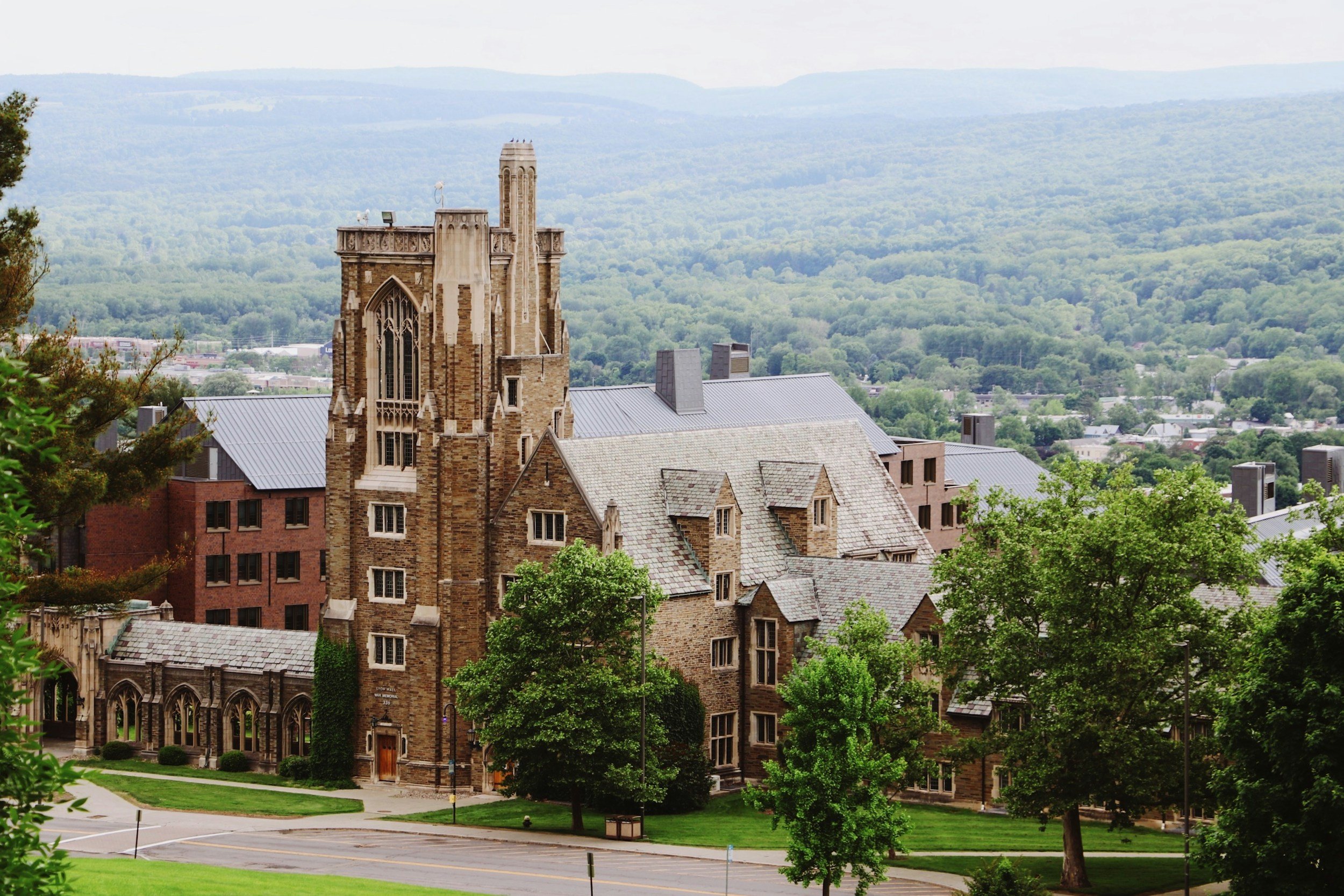
Cornell's stone clock tower overlooking a green valley and the town of Ithaca in the distance.
Cornell Supplemental Essays 2025–26: Complete Guide (With Examples)
Raj Hamlai
Cornell University Essay – Community (All Applicants, 350 words)
The prompt (paraphrased):
Choose one community that matters to you and explain how it has shaped you. Cornell lets you define “community” broadly (family, school, work, activities, identity, place, online, etc.). 350-word limit.
What this Cornell essay is really asking
Cornell wants to see:
How you move through the world (your context and lived experience)
What you notice, care about, and contribute
How a specific community has influenced your values, choices, or goals
This is less about the community being impressive and more about how it has formed you.
Strong ways to approach this prompt
Consider communities like:
A family business, multigenerational household, or caregiving role
A sports team, performance group, robotics or debate team
A neighborhood, town, religious group, or cultural community
A workplace, activism group, mutual aid effort, or online community
A niche interest group (e.g., fan translation server, open-source project)
Focus on:
One community + 1–2 specific moments
Your role in that community (what you did, not just what you received)
How that experience will travel with you to Cornell
Traps to avoid
Listing multiple communities instead of going deep on one
Writing a diversity statement that names identity but never shows lived experience
Spending nearly all your space describing the community rather than your growth
Turning this into a “Why Cornell” essay (save that for your college-specific prompt)
Sample community essay opening
On Thursday nights, our garage turns into a bicycle clinic. Neighbors wheel in flat tires and rusty chains, and my father hands me the patch kit without a word. At first, I saw it as free labor; now I see how a fixed bike lets a single mom make her night shift or an elderly neighbor avoid two bus transfers. In learning to repair frames and gears, I’ve also learned that quiet, consistent service can turn a street into a community that believes in one another.
You can feel the place, the role, and the shift in perspective—all in a short opening.
College of Agriculture and Life Sciences (CALS) – Why This Major at Cornell (500 words)
The prompt (paraphrased):
CALS admits you directly into a major. Explain why you are drawn to that major and why you want to pursue it specifically at Cornell CALS, using your interests, experiences, and goals. 500-word limit.
What CALS is looking for
A clear origin story for your interest (where did this begin?)
Evidence that you’ve developed that interest (courses, projects, research, work, family context)
A well-researched sense of why CALS, not just “why Cornell”
A sense of purpose—how you hope to use this major to tackle real-world challenges
Effective content to include
A specific moment or problem that first made you care (crop failure, food insecurity, animal health, environment, economics, etc.)
How you pursued this interest: clubs, internships, farm work, labs, independent projects
A few concrete CALS connections: majors, course themes, research areas, community-engaged learning, approaches that match your goals
A realistic future direction (it is fine not to have it all figured out)
Pitfalls to avoid
Copying language from the CALS website without adding your own voice
Vague statements like “I want to help the environment” with no personal stake
Presenting CALS as interchangeable with any other agriculture or life sciences program
Trying to cover every CALS resource instead of zooming in on the most relevant ones
Sample CALS essay excerpt
When late blight wiped out half the tomato crop on my grandparents’ farm in Puerto Rico, I watched my grandmother cut recipes from our menu to stretch what was left. That season turned plant disease from an abstract concept in biology class into a threat I could taste. Since then, I’ve spent weekends running soil tests for local community gardens and interning with a hydroponic start-up, fascinated by how plant pathology and data analysis can protect yields. At Cornell CALS, I hope to deepen this work through advanced plant-microbe courses and applied research on disease-resistant cultivars, preparing to support small farms like my grandparents’ as climate stresses intensify.
Notice how the excerpt ties a personal experience to a focused interest and to what the student hopes to do at CALS.
College of Architecture, Art, and Planning (AAP) – Why AAP and Your Major (650 words)
The prompt (paraphrased):
Explain how your interests connect with your intended major in AAP (Architecture, Art, or Urban and Regional Studies) and why this path at Cornell makes sense. Architecture applicants should discuss a creative project or passion that motivates them to pursue a five-year professional program; Art applicants may describe how they’d use Cornell’s resources to build a coherent practice; URS applicants should show depth of interest in urban and regional issues. 650-word limit.
What AAP is looking for
Genuine, sustained engagement with architecture, art, or urban studies
Comfort with creative process, iteration, and critique
Awareness that AAP is intense and professional-focused, especially for B.Arch
A clear sense of why AAP’s studios, resources, and locations are right for you
Strong approaches by intended major
Architecture (B.Arch)
Highlight design/build experiences: models, competitions, fabrication, design challenges
Discuss both aesthetics and function—how people actually inhabit space
Show that you understand the commitment of a five-year professional program
Art (BFA)
Focus on your artistic process rather than listing all media used
Show how you question, experiment, and respond to feedback
Explain how you’d use Cornell’s breadth (other departments, collaborations) to shape your practice
Urban and Regional Studies (URS)
Identify specific urban issues you care about (housing, transit, zoning, climate resilience, labor, public space)
Ground your interest in lived encounters with cities, suburbs, or towns
Show you can think across policy, design, and social impacts
Common missteps
“I like drawing buildings” without any deeper lens or critique
Treating cities as purely aesthetic backdrops instead of complex systems
Turning the essay into a portfolio tour; focus on one or two projects in real depth
Ignoring AAP’s collaborative, studio-based environment
Sample AAP essay excerpt (Architecture)
The first time I stayed up all night for a project, it wasn’t for a test—it was to rebuild a cardboard bridge that kept collapsing under a stack of textbooks. By dawn, I had redesigned the truss system three times and discovered that I loved the balance between elegance and physics. Since then, I’ve moved from cardboard to laser-cut basswood, but the obsession is the same: how can a line on paper become a form that holds weight, light, and people? At AAP, I’m excited by the iterative studio culture, where critiques push designs from “interesting” to inhabitable, and where I can explore sustainable materials in Ithaca’s landscape and beyond.
College of Arts & Sciences – Curiosity and Academic Journey (650 words)
The prompt (paraphrased):
Show how your passion for learning is shaping your academic journey. What areas of study or majors in Arts & Sciences excite you, and why? Explain how your interests align with the college and how you would use its curriculum and opportunities. 650-word limit.
What Arts & Sciences is looking for
A portrait of you as a genuinely curious thinker
A sense of how your interests developed, not just what they are
A few interconnected areas of study you hope to explore
Concrete ways you’d use the college’s breadth and depth
How to approach this Cornell essay prompt
Start with a moment that shows you chasing a question: reading beyond the syllabus, designing a project, debating an idea, connecting two fields
Trace how that curiosity led you to different disciplines (for example, statistics + sociology, biology + government, literature + computer science)
Connect your interests to the flexibility of Arts & Sciences, not just to one isolated major
Close with how you hope to grow intellectually at Cornell and beyond
Things that work well
Describing how one class led you to another, or how a project crossed subject boundaries
Showing how you deal with intellectual uncertainty or change your mind
Naming a few specific themes or questions that you could explore from multiple angles
Things to avoid
Simply listing all the Cornell departments you like
Rewriting your activities list or transcript
Centering prestige (“I want an Ivy League education”) instead of fit
Pretending you have a rigid, fixed academic plan if you do not
Sample Arts & Sciences essay excerpt
A single question from AP Chemistry—“Where else does this reaction happen?”—sent me spiraling into articles on atmospheric chemistry and podcasts on climate policy. I realized I was as fascinated by the politics of carbon markets as I was by the molecules themselves. That realization has shaped my schedule: I pair problem sets with town hall meetings, and scientific articles with policy briefs. At Cornell’s College of Arts & Sciences, I hope to explore that intersection through coursework in chemistry, government, and environment-related programs, preparing to translate rigorous science into policies that communities can understand and trust.
Cornell Jeb E. Brooks School of Public Policy – Why Policy at Brooks (650 words)
The prompt (paraphrased):
Why are you interested in studying policy, and why at the Brooks School? Explain how your current interests, experiences, and goals have influenced your choice of policy major. 650-word limit.
What Brooks is looking for
A specific policy area you care about (health, education, climate, housing, criminal justice, labor, etc.)
Evidence that you’ve engaged with that issue beyond headlines
Understanding of policy as design and evaluation of systems, not just political debate
A sense of why Brooks’s training and resources match your aims
Strong content choices
Personal or family experiences with systems: healthcare, schools, social services, immigration, workplace policies
Work or volunteering: clinics, nonprofits, campaigns, research, tutoring, community organizing
Data, research, or analysis you’ve done (school project, independent work)
A realistic path for how policy study could help you contribute
Missteps to avoid
Writing a partisan rant instead of a thoughtful exploration of an issue
Using “policy” and “politics” as interchangeable
Making sweeping promises (“I will fix the education system”) without any sense of scale
Spending all your time on “Why Brooks” and skipping your own story
Sample Brooks essay excerpt
Translating at my mom’s medical appointments, I watched a five-minute paperwork error add three months to her physical therapy. That delay wasn’t just frustrating—it meant pain, missed shifts, and lost income. Volunteering at a community clinic and analyzing local health outcomes for my senior project showed me how small administrative policies can create large inequities. At the Brooks School, I hope to study health policy design and evaluation so I can help build systems where language and paperwork are no longer barriers to care.
Cornell SC Johnson College of Business – What Kind of Business Student Are You? (650 words)
The prompt (paraphrased):
Using your personal, academic, and/or work or volunteer experiences, describe the topics or issues you care about and why they matter. Show how your interests align with either Dyson (Applied Economics and Management) or the Nolan School (Hotel Administration). 650-word limit.
What SC Johnson is looking for
How you think about business problems (not just that you “like business”)
A sense of what draws you to Dyson vs. Nolan
Evidence of initiative: projects, jobs, clubs, family business, entrepreneurship, hospitality roles
A values-driven approach to business: ethics, community impact, sustainability, guest experience, etc.
Strong approaches
For Dyson:
Focus on economics, markets, data, finance, sustainable business, agribusiness, policy, or entrepreneurship
Show comfort with analytical thinking and interest in impact
For Nolan:
Focus on hospitality, service, tourism, real estate, food and beverage, guest experience
Show how you think about creating spaces and experiences that people remember
In both cases, tie your experiences to questions: How should we price fairly? Source responsibly? Design a better guest experience? Measure impact?
Common pitfalls
Writing “I want to make a lot of money” as your core motivation
Rehashing your resume instead of reflecting on what you learned
Failing to clearly indicate Dyson vs. Nolan fit
Using buzzwords (“innovation,” “entrepreneurship,” “leadership”) without examples
Sample SC Johnson essay excerpt
When my aunt’s food truck raised prices to cover supply costs, weekday sales dropped by 20%. My spreadsheet did more than quantify the loss; it showed which neighborhoods and menu items still had the strongest margins. Together, we redesigned the menu, paired higher-margin dishes with customer favorites, and introduced a pay-what-you-can day that surprisingly increased overall revenue. Experiences like this have taught me to see business as a way to balance numbers with community needs, and they are why I’m drawn to studying applied economics and management at Dyson.
College of Engineering – Two Long Essays and Four Short Answers
Engineering applicants write two 200-word essays and four 100-word short answers.
Long Essay 1 – Why Engineering? (200 words)
The prompt (paraphrased):
Engineering uses math, science, and technology to solve complex problems. Why do you want to study engineering?
How to approach it
Show where engineering started for you (a project, class, problem, curiosity)
Highlight how you enjoy the process: debugging, iterating, testing, thinking in systems
Connect your interest to real-world problems you care about
Sample excerpt
I first understood engineering when my Arduino-powered soil sensor failed—spectacularly—in the middle of a heat wave, leaving our garden wilted. Debugging the wiring and rewriting the code taught me that engineering is not magic; it is patient troubleshooting with concrete consequences. That feeling—seeing a system fail, then slowly coaxing it back to life—made me want to study engineering so I can design tools communities can rely on when conditions are anything but ideal.
Long Essay 2 – Why Cornell Engineering? (200 words)
The prompt (paraphrased):
Why do you think you would love to study at Cornell Engineering?
How to approach it
Choose a few specific Cornell Engineering features that truly fit you: majors, project teams, labs, programs, approaches
Link each Cornell detail to something you have already done or want to do next
Emphasize the hands-on, collaborative culture
Sample excerpt
I am drawn to Cornell Engineering’s emphasis on learning by doing, especially through project teams. After designing simple phone apps to help seniors in my town manage medication reminders, I want to join a group like Cornell AppDev, where I can collaborate with designers and product managers to scale accessible tools. Coupled with coursework in computer science and opportunities for interdisciplinary work, that environment is exactly where I can see myself experimenting, failing, and building more useful systems.
Short Answer 1 – What Brings You Joy? (100 words)
How to approach it
Pick something specific and maybe surprising (baking with your sibling, restoring vintage keyboards, annotating books, stargazing, birding, etc.)
Show how you engage with it and what it says about you (curiosity, patience, creativity)
Sample excerpt
Re-shelving books at the library “wrong” brings me joy—at least temporarily. When I tuck a graphic novel into the physics section or a cookbook among the poetry, I know someone will stumble on it and pause. Those tiny, accidental intersections remind me that curiosity often starts with a misfiled idea, and that learning is more fun when it feels like discovery.
Short Answer 2 – Your Contribution and Unique Voice (100 words)
The prompt (paraphrased):
What will you contribute to Cornell Engineering beyond what is already in your application? What unique voice will you bring?
How to approach it
Focus on a non-technical dimension: mentoring, communication, bridging cultures, building community, arts, leadership style
Briefly show how you already live this contribution now, then project it forward to Cornell
Sample excerpt
As the only debater on my robotics team, I became the unofficial “translator” between our coders and the school board that funds us. I learned to explain PID loops without jargon and budgets without spreadsheets. At Cornell, I hope to keep bridging that gap—helping project teams communicate their work to non-engineers, especially in community partnerships where understanding builds trust.
Short Answer 3 – Meaningful Activity or Responsibility (100 words)
The prompt (paraphrased):
Describe one activity, work or volunteer experience, club, team, organization, or family responsibility that is especially meaningful to you.
How to approach it
Choose something that reveals commitment, character, or growth, even if it is not the most prestigious activity
Use a brief moment or scene to show why it matters
Sample excerpt
Every Sunday, I inventory supplies for my parents’ restaurant and update a hand-drawn chart in the kitchen. It is not glamorous, but tracking numbers turned shortages into patterns: rainy weeks meant fewer customers, which meant wasted produce. That simple chart became our shared planning tool—and my first lesson that even rough data, used thoughtfully, can make daily life more predictable.
Short Answer 4 – Award or Achievement (100 words)
The prompt (paraphrased):
Describe the award or achievement that has meant the most to you and why.
How to approach it
The achievement does not have to be the biggest; it should be the most meaningful
Focus on the process and growth behind the outcome
Sample excerpt
The “Most Improved” patch on my swim parka means more to me than any medal. For months, I finished last in every heat, but I kept a notebook of split times and tiny technique changes. When my coach handed me that patch, it recognized not speed, but persistence—and reminded me that slow, deliberate progress can rewrite stories I once believed about my limits.
College of Human Ecology (CHE) – Community or Career Challenge (600 words)
The prompt (paraphrased):
Identify a challenge in your greater community or in the career or industry that interests you. Explain how a CHE education, your chosen major, and the breadth of CHE majors will help you address that challenge. 600-word limit.
What CHE is looking for
A clearly defined challenge that you understand from experience
Insight into how that challenge affects people, not just numbers or headlines
An understanding of your intended CHE major, plus how other CHE areas connect
A human-centered approach to solving problems
Strong approaches
Challenges related to: food systems, health disparities, apparel and sustainability, aging populations, housing and interiors, family dynamics, policy and communities
Personal stories: caring for relatives, working in healthcare or service roles, volunteering in schools or shelters, research or design projects
A vision of how you might use multiple CHE perspectives (design + policy, nutrition + psychology, etc.) to tackle the problem
Pitfalls to avoid
Selecting a huge societal issue and staying abstract
Only describing your chosen major without mentioning the broader CHE ecosystem
Overstating what one person can do, rather than naming realistic steps
Sample CHE essay excerpt
When my grandmother moved into a nursing home, the brochure promised “accessible design,” yet she still got lost trying to find the dining hall. Doorways were wide enough for her wheelchair, but the signage, lighting, and furniture made every hallway feel identical. Watching her avoid activities because she was afraid of not finding her way turned accessibility into something painfully personal. I want to study Human Centered Design at CHE to rethink spaces for older adults, and pair it with coursework in policy and nutrition so I can help create environments where aging people can navigate, eat, and live with dignity.
School of Industrial and Labor Relations (ILR) – Topics and Issues You Care About (650 words)
The prompt (paraphrased):
Using your personal, academic, or work/volunteer experiences, describe the topics or issues you care about and why they matter to you. Show that your interests align with ILR. 650-word limit.
What ILR is looking for
Interest in work, employment, and organizations: workers’ rights, unions, HR, labor law, conflict resolution, diversity, gig work, global labor, etc.
Experiences that made these issues real to you (jobs, family work stories, organizing, research, clubs, debate)
Appreciation for multiple perspectives: employees, employers, governments, communities
A sense of how ILR’s mix of law, policy, economics, history, and organizational behavior fits you
Strong approaches
Reflect on a workplace you know: your job, a parent’s or relative’s job, or a community workplace
Highlight a situation that raised questions about fairness, safety, scheduling, pay, discrimination, organizing, or culture
Connect that situation to larger questions: How should work be structured? What is fair? What makes an organization healthy?
Pitfalls to avoid
Treating ILR as “business lite” or generic pre-law
Writing about politics without tying it back to work and employment
Staying purely theoretical with no lived or observed examples
Sample ILR essay excerpt
When the café where I work cut hours with no warning, my coworkers and I compared notes on missed rent payments while my manager apologized with red eyes; she had learned about the change from an email sent at midnight. Listening to her juggle corporate targets and our bills made the line between “us” and “them” blur. That moment sparked my interest in how contracts, labor law, and organizational design could turn sudden shocks into transparent, negotiated changes. At ILR, I hope to study how workplaces can balance power more fairly for everyone involved.
Bringing Your Cornell Essays 2025–26 Together
Across all these Cornell essay prompts 2025–26, admissions officers are asking versions of the same questions:
Who are you in your community, and how have your experiences shaped you?
How do you think, learn, and solve problems?
Why is this particular Cornell college or school the right place for your next chapter?
How will you contribute once you are there?
As you draft your Cornell supplemental essays with examples like the ones above, keep an eye on the whole application:
Make sure each essay shows different facets of you (not the same story repeated).
Check that your college- or school-specific essay answers both “Why this field?” and “Why Cornell here?”
Use the community essay to anchor your values and background, and the college-specific essay to show direction and fit.
If you do that, your Cornell essays 2025–26 will feel cohesive, authentic, and purposeful—exactly what Cornell is hoping to see.
Want expert feedback on your Cornell essays? Schedule a free consultation with Momentum College Prep.
Want the guide to go? Download it here